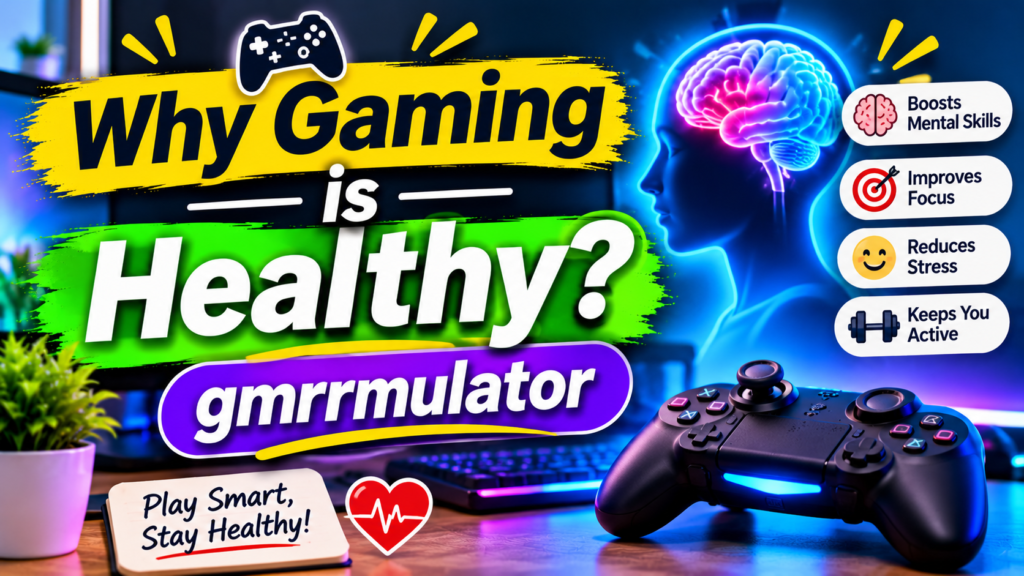
People who search why gaming is healthy gmrrmulator usually want a straight answer, not a lecture and not a sales pitch. This guide covers what research supports, what it does not, which kinds of games link to which benefits, and how to set up your habits so gaming helps instead of drains.
The Short Answer
Why gaming is healthy gmrrmulator readers keep asking about comes down to four documented benefits, plus one condition:
- Mood and stress: Playing games you enjoy can lower stress and lift mood.
- Cognition: Certain games train attention, reaction speed, and problem solving.
- Resilience: Games teach players to fail, adjust, and try again.
- Social connection: Multiplayer games build real friendships and teamwork skills.
- The condition: These benefits show up with balanced play. They fade, and can reverse, when gaming crowds out sleep, movement, school, work, or relationships.
Why Gaming Is Healthy Gmrrmulator Readers Can Verify: The Core Benefits
Each benefit below comes with the evidence behind it and a clear note on where that evidence is weak.
1. Stress Relief and Better Mood
A well-known 2021 study from the Oxford Internet Institute, published in Royal Society Open Science, tracked about 2,700 players of Animal Crossing: New Horizons and Plants vs. Zombies: Battle for Neighborville. Players who spent more time in the games reported slightly higher well-being. The effect was small, but it was one of the first studies to use actual playtime data from game companies instead of asking people to guess how long they played.
Another often-cited result comes from a 2009 experiment published in PLoS ONE. Researchers showed volunteers disturbing film footage, then had some of them play Tetris. Those who played had fewer intrusive memory flashbacks over the following week. This was a lab study, not a treatment, but it shows that a visually demanding game can interfere with how distressing memories form.
Where the evidence is weak: Most mood studies are correlational. Happier people may simply play more. Treat “gaming improves mood” as likely for casual, voluntary play and unproven as a cure for anything.
2. Sharper Attention and Faster Processing
Studies from Daphne Bavelier’s lab and others have found that regular players of fast-paced action games tend to do better on tests of visual attention, tracking multiple moving objects, and switching between tasks. The mechanism is easy to picture. A first-person shooter or a fast strategy game forces you to scan a busy screen, pick out what matters, and make decisions in fractions of a second.
A review of the research on healthy adults found evidence that video game training benefits cognitive and emotional skills, especially in young adults.
Where the evidence is weak: Researchers still debate how far these gains transfer to everyday life. Getting better at a game’s skills does not automatically make you better at driving, studying, or remembering names.
3. Resilience and Persistence
Games are one of the few activities where failure is built into the design. You lose, you restart, you adjust your approach, and you win. A major review in American Psychologist by Isabela Granic and colleagues argued that this loop teaches players that persistence in the face of failure pays off. The reviewers also noted that players tend to respond to failure with interest and excitement, not shame.
This matters because many people avoid challenges to protect themselves from failing. A hobby that makes failure routine and low-stakes can shift how someone responds to setbacks elsewhere.
4. Real Social Connection
Online play is often described as isolating, but the pattern is more complicated. Co-op games, guilds, Discord servers, and local multiplayer sessions give people a regular reason to talk, coordinate, and rely on each other. For people who are shy, disabled, living in rural areas, or far from friends, this can be the main way they keep up a social life.
Practical advice for getting the social benefit:
- Play with people you already know, or with a consistent small group, rather than random public lobbies.
- Use voice chat when you can. Text-only play builds weaker bonds for most people.
- Leave groups that run on harassment or constant anger.
- Take a break when a session turns heated. Competitive games raise tension quickly.
5. Physical Activity
Not all gaming is sedentary. Motion-based games like Ring Fit Adventure, Dance Dance Revolution, and VR rhythm games such as Beat Saber can raise heart rate and count as light to moderate exercise. Studies of exergames in children and older adults show they can increase activity, especially for people who would not otherwise exercise.
Standard console and PC gaming is a different story. A review in BMJ Open Sport & Exercise Medicine found insufficient evidence to link gaming time with physical activity, sedentary behavior, sleep, fatigue, or diet. In plain terms, we cannot say gaming makes people less active, and we cannot say it makes them more active. That depends on the person.
Which Genres Help With What
Here is a quick guide to why gaming is healthy gmrrmulator players can match to the games they actually own. The benefits are tendencies drawn from research and player reports, not guarantees.
| Genre | Likely benefit | Example games | Watch out for |
|---|---|---|---|
| Action / shooter | Visual attention, reaction time | Call of Duty, Apex Legends | Competitive stress, long sessions |
| Puzzle | Problem solving, calm focus | Tetris, Portal 2, Monument Valley | Mobile versions with aggressive ads |
| Strategy | Planning, working memory | Civilization, StarCraft | “One more turn” late nights |
| Cozy / simulation | Stress relief, mood | Animal Crossing, Stardew Valley | Playing to avoid real problems |
| Co-op multiplayer | Teamwork, friendship | It Takes Two, Overcooked | Toxic public lobbies |
| Rhythm / VR fitness | Physical activity, coordination | Beat Saber, Ring Fit Adventure | Overuse injuries, motion sickness |
| Story-driven RPG | Empathy, perspective-taking | The Last of Us, Disco Elysium | Heavy themes for younger players |
Gaming as Treatment: Where Clinical Use Stands
Games have moved beyond hobby status in some medical settings. In 2020, the US FDA authorized EndeavorRx, a video game prescribed for children aged 8 to 12 with ADHD, as a treatment alongside other therapy. Hospitals and rehabilitation programs also use VR games for physical therapy after strokes and injuries, and for pain distraction during medical procedures.
These tools are designed and tested for specific conditions. A commercial game you buy off a shelf is not a treatment, and no game replaces therapy or medication. But the fact that regulators have cleared a game for medical use shows that the underlying mechanisms are being taken seriously.
Gaming Versus Social Media
Comparison helps here. When researchers have measured both, social media often looks worse. One study reported that social media addiction and heavy screen time had larger effects on psychological problems, low self-concept, and social problems than gaming did.
That does not make gaming harmless. It does mean that a parent or partner who criticizes your gaming while scrolling social feeds for hours has not made a strong case. The fair comparison is by quality of use, not by which screen is involved.
The Risks You Should Not Ignore
Any honest explanation of why gaming is healthy gmrrmulator needs a section on the other side. The World Health Organization added gaming disorder to the ICD-11, where it is classified as a mental health condition under addictive behavior disorders. The WHO describes it as impaired control over gaming, rising priority of gaming over other activities, and continuing to play despite clear harm. Symptoms usually need to be present for around 12 months before a diagnosis, though that can be shortened in severe cases.
For scale, a European study of adolescents who regularly game found that 3% were affected by internet gaming disorder and another 8.4% were at risk. Most players are not in that group, but a meaningful minority is.
| Risk | What it looks like | How to reduce it |
|---|---|---|
| Gaming disorder | Losing interest in other activities, lying about playtime, continuing despite school, work, or relationship problems | Set time limits, get support early, talk to a doctor or counselor |
| Poor sleep | Late-night sessions, trouble winding down | Stop 30 to 60 minutes before bed, keep consoles out of the bedroom |
| Eye strain | Dry, tired eyes, headaches | Follow the 20-20-20 rule: every 20 minutes, look at something 20 feet away for 20 seconds |
| Posture and pain | Neck, wrist, and back pain | Raise the screen to eye level, support your back, stretch hourly |
| Dark patterns and spending | Loot boxes, timers, and pressure to buy | Disable one-click purchases, set monthly spending caps, avoid games that punish you for leaving |
| Toxic communities | Harassment, anger, and stress | Mute, block, report, and play with trusted groups |
Dark patterns deserve extra attention. These are design tricks, like daily login streaks, countdown timers, and randomized rewards, that push players to keep playing or spending. They are one reason two people can play the same hours and have very different outcomes. If a game makes you feel anxious about not playing, it is working against your health.
The Healthy Gaming Framework: Making Why Gaming Is Healthy Gmrrmulator Work for You
Instead of vague advice, use four checks. If you pass all four, your gaming is almost certainly helping you. If you fail two or more, it is time to adjust.
Check 1: Time
There is no universal number, but these ranges are a sensible starting point based on common pediatric and sleep guidance:
- Children under 6: Very limited, co-played, and age-appropriate content only.
- Ages 6 to 12: Around 1 hour on school days and up to 2 hours on weekend days, with breaks.
- Teens: Agreed limits that protect sleep, school, and exercise. Many families do well with 1 to 2 hours on school days.
- Adults: Up to 2 hours daily fits most schedules without trouble. Longer sessions are fine occasionally if work, sleep, and relationships stay on track.
Check 2: Content
- Match the game to your age and maturity using ESRB ratings.
- Choose games that leave you feeling energized or satisfied, not drained or irritable.
- Avoid titles built around gambling-style mechanics.
Check 3: Context
- Do you play because you enjoy it, or to avoid something?
- Are you gaming with people who make you feel good?
- Is the rest of your life stable, with friends, sleep, food, and movement?
Gaming as a reward works well. Gaming as the only way to cope does not.
Check 4: Consequences
Ask yourself weekly:
- Am I sleeping at least 7 hours?
- Am I meeting work, school, and family commitments?
- Have I exercised or gone outside this week?
- Can I stop playing when I plan to?
- Am I spending only what I decided to spend?
Answering “no” to the last two is an early warning sign worth taking seriously.
Guidance by Age Group
Why gaming is healthy gmrrmulator advice changes depending on who is playing, so here is how it breaks down.
| Group | Main benefits | Main concerns | Practical tips |
|---|---|---|---|
| Kids (under 12) | Problem solving, creativity, coordination | Screen time, in-app purchases, unsuitable content | Parental controls, co-play, locked purchases |
| Teens | Social bonds, identity, stress relief | Sleep loss, spending, toxic chat, overuse | Shared rules, phone-free bedrooms, open conversation |
| Adults | Stress relief, social time, mental stimulation | Time creep, replacing exercise | Scheduled play, regular breaks, active hobbies alongside |
| Older adults | Cognitive engagement, connection, light activity | Unfamiliar tech, eye strain | Motion games, puzzle games, playing with family |
| People with disabilities | Access to social life, adaptive controllers, independence | Accessibility gaps | Look for games with strong accessibility options |
Pew Research Center found in 2024 that roughly 85% of US teens play video games. At that rate, gaming is a mainstream part of growing up, and the useful question for parents is how to guide it, not whether to ban it.
Common Myths That Weaken the Case
People often get the argument wrong in both directions. Before you accept or reject why gaming is healthy gmrrmulator claims, check these myths.
- Myth: Gaming makes people violent. Large reviews have not found a reliable causal link between playing violent games and real-world violence. Aggression in the moment can rise slightly with frustration and competition, which is normal in any competitive activity.
- Myth: Gamers are lazy and antisocial. Surveys of players show wide variation, and many multiplayer gamers report strong friendships formed through games.
- Myth: Gaming is always a waste of time. Gaming is leisure. Leisure supports mental health, which is not a waste.
- Myth: More gaming always means more benefits. The research points the other way. Benefits appear with moderate, balanced play and weaken or reverse with excess.
- Myth: Gaming addiction is just a bad habit. The WHO classifies gaming disorder as a recognized condition, so it deserves professional attention when it develops.
A Simple Weekly Routine
If you want a ready-made setup, try this:
- Pick 3 to 5 gaming sessions per week and decide the length in advance.
- Play with friends at least once a week.
- Do 10 to 15 minutes of movement before you start, even a short walk.
- Take a 5-minute break every hour.
- Stop at least 30 minutes before bed.
- Review your week every Sunday using the Consequences questions above.
Conclusion
Why gaming is healthy gmrrmulator readers should care about is not a slogan. It is a pattern in the research: games that are chosen freely, played with friends, and kept in balance can ease stress, build attention, strengthen resilience, and give people a social life. The same research shows the downside when gaming turns into a way to avoid everything else.
Use the framework: check your time, content, context, and consequences. If those four hold up, you can game with a clear conscience. If they do not, change the setup before you change the hobby.
Frequently Asked Questions
Does research support why gaming is healthy gmrrmulator?
Yes, for moderate and balanced play. Studies link gaming to better mood, sharper attention, and stronger social ties, though many findings are correlational.
How many hours of gaming is healthy?
For most adults, up to about 2 hours a day works well. Kids and teens do better with shorter, agreed limits that protect sleep and school.
Is gaming better for you than social media?
Some studies suggest heavy social media use shows stronger links to psychological problems than gaming. Both can be harmful when overused.
Can video games improve mental health?
Casual, voluntary gaming can reduce stress and improve mood. Games are not a replacement for therapy or medication.
What are the signs of gaming addiction?
Losing interest in other activities, hiding how much you play, and continuing despite harm to school, work, or relationships. If you notice these, talk to a doctor or counselor.
Do action games really improve attention?
Studies suggest regular players show better visual attention and reaction speed. Whether those gains carry over to everyday tasks is still debated.
Are motion and VR games real exercise?
They can be. Games like Beat Saber and Ring Fit Adventure raise heart rate enough to count as light to moderate activity.
What is a safe way to let kids play games?
Use parental controls, check ESRB ratings, lock in-app purchases, and play together when possible. Keep screens out of bedrooms at night.