Ask most people where the internet “lives” and they’ll point at a data center. Fair enough. Amazon and Google pour billions a year into those buildings, and they’re the ones that make the news.
But a big chunk of the network sits somewhere far less glamorous: the router blinking under someone’s TV. Home connections are where traffic actually ends up, and they’ve got something a rented server can’t really fake (a reputation as an ordinary person at home).
From Backbone to Living Room
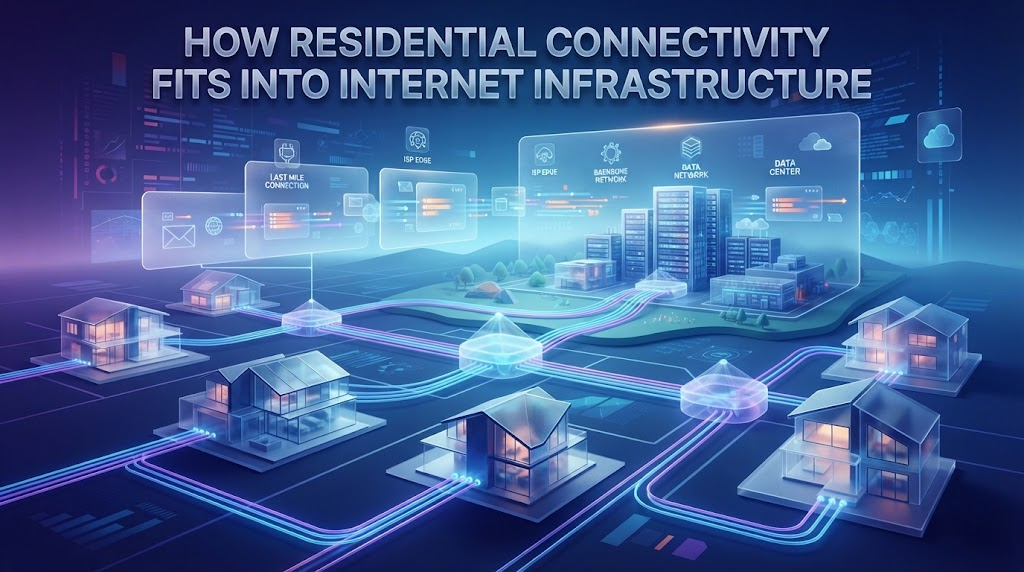
The internet works a bit like a road system. Big carriers such as Lumen and NTT own the motorways (long-haul fiber, undersea cables), regional networks run the city streets, and the local ISP builds the driveway up to the front door.
Those roads connect in two ways. Networks either pay each other for transit or swap traffic for free at exchange points like DE-CIX in Frankfurt, which is one of the busiest anywhere.
The driveway is where a home gets its public IP address. The ISP hands it out from a block registered under its own name, so anyone who looks it up can tell it belongs to a consumer provider and not some hosting company. That’s the whole reason proxies routed through real home connections exist; IPRoyal’s blog post on residential proxies definition covers where those IPs come from and why sites treat them like regular visitors.
Engineers have a name for that driveway: the last mile. It’s still the priciest part of any network to build, since digging up a residential street costs way more per customer than lighting one more strand of backbone fiber.
Why an IP Address Has a Reputation
Every IP block belongs to what’s called an autonomous system, basically a network that registers itself publicly and sets its own routing rules. Cloudflare’s explainer on autonomous systems does a good job of showing how these networks tell each other where traffic should go using BGP.
Fraud checks look at that registration all the time. An address from Comcast or Deutsche Telekom? Probably someone on their couch. One from a cloud host? Probably a script (and honestly, it usually is).
The catch is that the system’s messier than it looks. IANA gave away its last free IPv4 blocks back in February 2011, and Europe’s registry, RIPE NCC, ran out in November 2019.
So plenty of ISPs now squeeze hundreds of homes behind one shared address with carrier-grade NAT. If one person on that address does something shady, a bank might block the whole lot, neighbours included.
Not Everyone Has a Home Connection Worth Talking About
Coverage is wildly uneven. The ITU’s Facts and Figures 2024 report puts the number of people online at about 5.5 billion, or roughly 68% of the planet.
That leaves 2.6 billion people offline, and 1.8 billion of them live in rural areas. In cities, 83% of people use the internet; in the countryside it drops to 48%.
Money’s a big part of it. In low-income countries a fixed broadband plan can eat close to a third of someone’s monthly income, so most people just get by on their phone and mobile data.
For anyone building something online, this matters more than it sounds. An app tested on gigabit fiber in Stockholm can feel completely broken on a patchy DSL line out in the country. Testing on a throttled connection takes ten minutes, and it’s worth doing.
The Router Is Usually the Weak Spot
Home setups leak more than people think. Unless encrypted DNS is switched on (Firefox and Chrome both support it), the ISP can see every site a household looks up.
Then there’s the gear. Smart TVs and cheap doorbells rarely get updates, and the weakest device on a home network is often one nobody remembers plugging in.
Routers aren’t much better. Some ISPs still ship boxes with default admin logins, which is partly why the UK banned universal default passwords on new connected devices in 2024.
Where Home Networks Go Next
Home speeds keep climbing. Fiber-to-the-home rollouts and Wi-Fi 7 routers are getting households close to what a data center offered ten years ago, so the raw speed gap is shrinking fast.
The trust gap isn’t, though. And as IPv6 spreads and every device can get its own public address again, the old tricks for spotting “a real household” will have to change, which probably makes home networks even more central to how the web decides who’s legit.