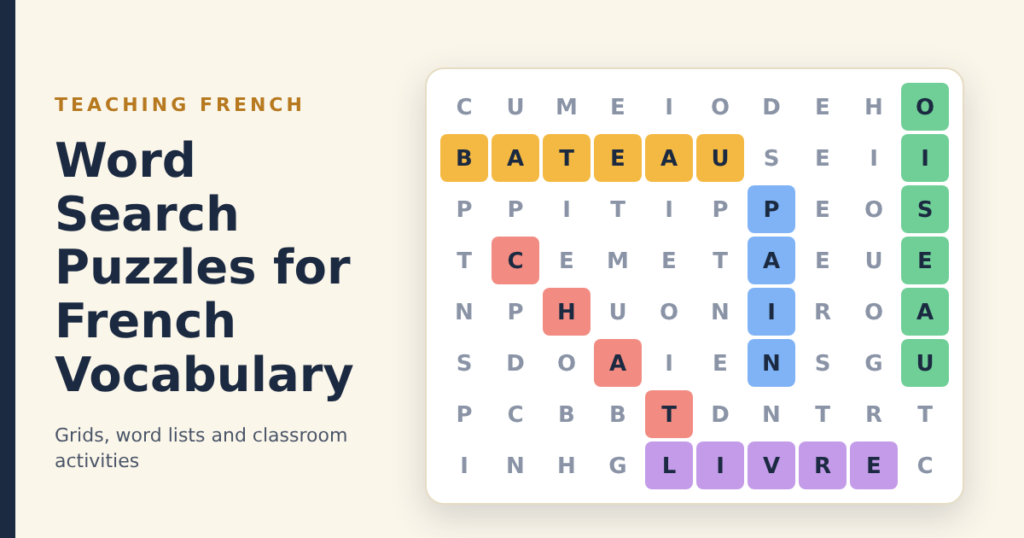
Vocabulary is the part of French that never stops growing. Grammar rules can be learned in a term, but the words keep coming: food, family, weather, school, transport, feelings. Learners need many short, repeated encounters with the same words, and those encounters need to be more engaging than copying a list.
Word search puzzles fill that gap. They are quick to prepare, easy to adapt, and familiar to almost every learner. Used well, a grid is not a time-filler. It is a structured way to see, say, spell and use a set of words. This guide explains how to choose grids, build word lists, run activities and avoid the most common mistakes.
Why Word Searches Work for Vocabulary Practice
A word search asks a learner to hold a target word in mind and scan a field of letters until it appears. That small loop repeats for every word on the list. Each find is a minor success, and the learner has looked closely at the spelling several times before the grid is complete.
Three features make the format useful in a language lesson. First, the task is self-checking: the word is either in the grid or it is not, so learners can work alone without waiting for feedback. Second, the word list is visible, which lowers anxiety for beginners and gives them correct spellings to refer to. Third, the format is flexible. The same layout can carry animals, school objects, months or verbs, so one routine can serve a whole year of topics.
A word search is not a complete method. It trains recognition and spelling more than speaking or grammar. It works best as one step in a sequence: introduce the words, practise them in a grid, then use them in speech or writing. The rest of this article shows how to build that sequence.
What a Word Search Trains in a French Learner
Visual scanning and letter patterns
French spelling includes combinations that do not match English habits: eau, ou, oi, ch, gn, qu, ill. Hunting for words such as bateau, oiseau or montagne makes learners look at those clusters again and again. Over time they start to see “eau” as one unit rather than three separate letters.
Whole-word recognition
Learners who decode letter by letter read slowly. Finding a word in the middle of a grid, sometimes reversed or on a diagonal, pushes them to recognise the overall shape of the word instead of sounding it out.
Spelling
Seeing a correct spelling five or six times in one sitting helps it stick, especially when the grid is followed by writing the word from memory. That follow-up step is covered in the activities below.
Attention and persistence
A grid is a short task with a clear end. Learners who struggle with long worksheets often finish a grid, and finishing builds willingness to try the next one.
A caution about accents
Many puzzle grids remove accents because each cell holds one plain capital letter. A word such as “été” appears as ETE. Treat the grid as a recognition task, and always ask learners to write the word with its accents afterwards. Accents are part of French spelling, and a puzzle should not teach otherwise.
Choosing the Right Grid Size and Difficulty
Grid difficulty depends on more than size. The number of words, their length and the directions allowed all change the load on the learner.
- Small grids (about 8×8) with short words placed left to right and top to bottom suit beginners and young children. The learner can find every word without needing a strategy.
- Medium grids (about 10×10) add longer words and more entries. They suit learners who read fluently and already know the topic vocabulary.
- Larger grids (about 12×12) with diagonal and reversed words suit confident readers and revision sessions, where the goal is to test recognition under pressure.
Match the grid to the learner’s reading level, not their age. A teenage beginner may need an 8×8 grid on a new topic, while a younger child who has met the words many times can handle a larger one.
Word length matters as well. Words of three to five letters, such as chat or pain, are easy to spot. Words of eight letters or more, such as bibliothèque or anniversaire, take longer and are easier to confuse with similar-looking strings of letters. Keep long words to a minimum in the first grid of a topic.
If you teach in a French primary school, a level-by-level structure helps. This word search teaching guide for primary classrooms lays out typical grid sizes and word-list focus for each level from CP to CM2, which makes a useful reference when you are deciding where to start.
Building Word Lists That Actually Teach
The list matters more than the grid. A random list produces a puzzle. A planned list produces learning. These rules keep lists useful:
- Keep it themed. Group words around one topic, such as la ferme, l’école or la météo, so related vocabulary is learned together and recalled together.
- Use 8 to 15 words. Fewer than eight feels thin. More than fifteen turns the task into a chore, especially for beginners.
- Mix familiar and new words. Aim for about two-thirds known words and one-third new ones, so the grid builds confidence while still stretching the learner.
- Show the article. In the class list, write nouns with le, la, un or une, even if the grid hides them. Gender is easier to learn attached to the word than as a separate rule.
- Use cognates on purpose. Words like restaurant, animal and musique look like their English equivalents and give quick wins.
- Flag the false friends. Librairie means bookshop, not library. Collège is a school for ages 11 to 15, not a university. Actuellement means “currently”, not “actually”. Add a short list of these to the lesson, not to the grid.
Custom lists let you match the puzzle to your current unit. Most free grid generators let you paste in your own words, which takes a few minutes and keeps the practice tied to what you are teaching this week.
Classroom Activities That Go Beyond Finding Words
The grid is the start of the activity, not the end. These routines turn recognition into recall and use.
- Warm-up scan (five minutes). Hand out a themed grid at the start of the lesson. Learners find as many words as they can while you take the register. Review the list aloud afterwards, with the class repeating each word.
- Spell from memory. After the grid, learners turn the sheet over and write as many words as they can remember, accents included. Check against the list. The gap between found words and remembered words shows what to revisit.
- Sort by gender. Learners group the nouns into le and la columns. This turns a recognition task into grammar practice with real vocabulary.
- Sentence builders. Each pair picks three words from the grid and writes a sentence for each. Stronger learners add an adjective or a verb.
- Answer-key review. Go over the solutions together and ask which words were hardest to find and why. Learners often discover that they overlooked words with double letters or silent endings.
- Mixed-level groups. Give different grids to different groups on the same topic. Beginners get a small grid with the base words, and confident learners get a larger one with extra vocabulary, so everyone works on the same theme at their own level.
- Early finishers. Give a second grid, or ask them to design one for the class. Creating a puzzle forces careful spelling.
If some learners find reading difficult, project the word list on the board while they work on paper. Seeing the target spelling in large print supports them without singling them out.
Using Word Searches at Home and for Self-Study
Parents and independent learners can use the same ideas without a classroom. Pick a topic the learner meets in daily life: kitchen words for cooking, travel words before a trip. Print the grid, find the words, then use them for something real, such as labelling objects around the house with sticky notes or writing a shopping list in French.
Short sessions work better than long ones. Ten minutes a day on a themed grid, followed by one minute of saying the words out loud, is more useful than an hour once a week. Keep a vocabulary notebook where the learner copies the words they missed.
Parents who do not speak French can still help. Read the word list aloud with the help of an online audio dictionary, or ask the learner to teach three words to you. Teaching is one of the best ways to consolidate what has been learned.
Printable and Online Options
Printing is practical. It needs no screen, it is easy to annotate, and learners can circle words with a pencil. Look for black-and-white PDFs in A4 or letter size that print cleanly, with the answer key on a separate page.
If you want ready-made material, Hibou & Mots publishes free French word search puzzles that you can play online or print as A4 PDFs with the solutions included, alongside crosswords, sudoku and other letter games.
Whichever source you use, check three things before handing out a grid: the spelling of every word is correct, the vocabulary suits the learners, and a solution is available so you can verify that every word is actually in the grid.
Common Mistakes to Avoid
- Using the grid as a time-filler. Handing out a puzzle to keep a class quiet wastes the vocabulary opportunity. Always follow it with review.
- Overloading the list. Too many new words in one grid turns practice into frustration. Keep new words to a handful.
- Ignoring accents and gender. Hidden accents and missing articles teach incomplete spelling. Add both in the follow-up.
- Skipping the answer review. Learners who never see the solutions cannot learn from the words they missed.
- Using the same difficulty every time. Rotate grid sizes so learners stay challenged without becoming discouraged.
- Treating finding as knowing. Recognising a word in a grid does not mean a learner can recall or use it. Test with the spell-from-memory step.
A Simple Four-Week Routine
Week 1. Introduce ten words on one topic, such as food. Show them with pictures, say them aloud, then complete a small grid. Finish with spelling from memory.
Week 2. Review the week-one words in a warm-up scan, then add five new words in a medium grid. Sort the nouns by gender.
Week 3. Use a larger grid that mixes both topics. In pairs, learners write sentences with words they choose from the grid.
Week 4. Each learner builds a puzzle from ten words of their choice, swaps it with a partner and solves the partner’s grid. End with a short spelling check.
By the end of four weeks, learners have met each core word through reading, scanning, writing and use in a sentence. That repeated, varied exposure is what vocabulary learning depends on, and the routine takes only a few minutes of each lesson.
Final Takeaway
Word search puzzles are simple, and that simplicity is their advantage. A well-chosen grid takes minutes to prepare, works for learners of different levels, and gives repeated, focused contact with correct spellings. The value comes from the planning around it: a themed list, the right grid size, accents and gender added back in, and a follow-up task that asks learners to recall and use the words.
Start with one topic, one small grid and one follow-up activity. Watch which words learners still miss, and build the next list around them. Over a term, that loop will do more for vocabulary than any single puzzle. Keep the sessions short, keep the topics connected, and let each grid prepare the ground for speaking and writing.